New
Book Launches At Last!
New
Book Launches At Last!
WE ARE REALLY GLAD to say that after months of work,
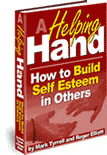
our new ebook ‘A Helping Hand - How to Build Self Esteem in Others’
is now complete!
As a newsletter subscriber, you can get the book
at 20% off before April 14th as part of our launch offer.
Click
here to get the book at 20% off
To read more about the book, see this issue’s
book review.
(The book is only available in electronic format
as a download from the website.)
Storytelling Workshop Now
Two Days
IF YOU HAVE attended the Saturday of the storytelling
workshop you may like to know that you can now attend the Sunday
too!
Rob Parkinson, the workshop presenter has added another
packed day to his popular course in storytelling and metaphor skills.
The price for the full workshop is £89. If
you have attended the Saturday previously, you can come to the Sunday
for £30.
The workshop is to be held in Brighton on May 10/11
and as there are only 20 spaces available, if you are interested please
call soon!
Top Tip
The ‘You / Not You’ Switcheroo
THIS Top Tip comes from our new ebook.
The technique is to change from skills to attributes
or vice versa, depending on whether someone’s statement about themselves
is positive or negative.
An attribute is something ‘unchangeable’,
whereas a ‘skill’ is something that can be learned or altered.
Here’s an example of changing a negative attribute into a skill,
and therefore making it less damning:
“I just haven’t got any willpower”
- into...
“Yes, we’ll have to find out what really motivates you.”
And the other way round - a positive skill into an
attribute:
“I quite like gardening”
- into...
“Yes, you do seem to have green fingers”
So by a simple reframe, you are aiming to change
someone’s impression of themselves.
This is something you can do for other people and
for yourself.
|
|
 Startling
Statistic Startling
Statistic
Unreal Outcomes
SCHIZOPHRENIA for most people is a terrifying spectre,
portrayed by the media as a life-sentence of madness and violence.
It is even less well known that you stand a much
better chance of recovery if you live in a country where they can’t
afford to treat you with so-called ‘anti-psychotic’ drugs.
From a World Health Organisation study, and subsequently
confirmed by others, your chance of complete recovery from psychosis
in a ‘third world’ country is 64% when your treatment is typically
a low stress environment and community support.
A further 12% recover to a ‘satisfactory’
level (neither fully recovered nor chronically ill).
This is as long as you are not treated with antipsychotics.
In a developed country where the typical treatment is by drugs, your
chance of complete recovery is 18%. ‘Satisfactory recovery’
runs at 17%.
Competition
Win the Top Book!
Win the Top Book!
ANSWERS as usual by post or email to:
competition@uncommon-knowledge.co.uk
Remember to include your postal address in case you
win!
Here’s the question:
According to this issue’s Startling Statistic,
how much more likely are you to recover completely from a psychotic
episode in a third world country than in a developed one?
A) 46%
B) 22%
C) 16%
The first three correct answers drawn on July 1st
will win a copy of this issue’s top book ‘A Helping Hand -
How to Build Self Esteem in Others’.
The correct answer to last issue’s question
was C) Improve your immune function.
The 3 lucky winners of ‘The
Healthy Mind, Healthy Body Handbook’ are: Rob Learner, Gloucester
UK, Elsie M Ozaka, Wilmington, USA, Dianna Bruno, New York USA.
 Top
Book Top
Book
Read review here:
How to Build
Self Esteem in Others
|
|
“Our doubts
are traitors that make us lose the good we oft might win by fearing
to attempt.”
William Shakespeare
You know what it’s like when you
have to do something you haven’t done before, or something that
you find scary? You have natural doubts; but how often do you listen
to them more than you think about the possible benefits, or the joy
of the experience?
Although fear is compelling, having
doubts doesn’t mean that there is any truth in them. Doubts don’t
have a monopoly on truth - you can prove them wrong, or sometimes just
ignore them altogether!
Q: What are your doubts convincing
you of? How much more would you be capable of if you listened to them
less?
|