 Celebratory Status Celebratory Status
HYPNOTHERAPY and Uncommon Knowledge found themselves in the national media spotlight on the 3rd of April. Andy Cripps, a trainee on the current Diploma course in Hypnotherapy and Psychotherapy, couldn’t have known what he was getting himself into when he cured an office-working executive chap of his habit of eating £50 of biro pens a month. Not only were The Evening Argus rather fascinated, but also The Sun, The Telegraph, The Times, The Mirror, Meridian News, Radio One, Two and Four and, cobbers, Australian radio! If anyone heard the story anywhere else, we’d love to know! We’re not sure BIC are so pleased though! Stories Are The Business ACCORDING to The Harvard Business Review, the latest business-training tool is traditional story telling. Learning to tell excellent tales masterfully is becoming all the rage within business centres in the States and is catching on over here too. Of course, the ability to paint pictures with your words is often also a mark of great salespeople, leaders and hypnotherapists. So whether you want to use stories in training, at work, in therapy, or with kids, there is still time to book onto the Uncommon Knowledge storytelling workshop. Hosted by professional storyteller and trainer Rob Parkinson, the workshop takes place on Saturday 13th April (2002) in Brighton. The workshop is £59 and you can book by calling the office on 01273 557799. It promises to be a fascinating and fun day! (And no, you won’t have to tell a story to the group.) Hypnosis Gets Real! HYPNOSIS is now a proven state! Science has finally caught up with those who have been using and benefiting from hypnosis for centuries. According to scientists at Stanford and Harvard universities, when visualising colours, the brains of hypnotised subjects receive more bloodflow to a region called the fusiform gyrus. This is seen this as ‘incontrovertible proof’ that hypnosis is a distinct psychological and physiological state.’ This will be a blow to the ‘non-state’ theorists who posited the idea of hypnosis as social compliance as apposed to a distinct state of mind and body. Interestingly, brain scans of subjects during night-time REM dreaming show very little difference from scans of people when awake, (including altered bloodflow), but no one has ever suggested that dreaming is a figment of the imagination. Top Tip Sounds Good A RECENT study in America has discovered a useful aid to pain management - listening to your favourite music. Five hundred people recovering from major abdominal surgery were offered the usual pain relieving drugs alone, or the medication plus a tape of their favourite music. The group who listened to a musical tape had significantly less pain than those who used drugs alone. This phenomena has been called audioanalgesia and has also been shown to be effective during childbirth (particularly when the volume is turned up). Even pain caused by terminal illness has been helped by listening to music. Not recommended for headaches.  Startling Statistic Startling Statistic Me, Myself and I FOR years, people have been encouraged to focus more on themselves in pursuit of ‘self-discovery’. However, much research points to good mental health requiring the individual to focus attention away from the self. The extent to which people are self-referential and use personal pronouns such as: ‘Me, myself, mine, I, ’ in every day conversation has been shown to correlate with mortality rates and incidence of mental illness. On average, the more personal pronouns used, the bleaker the outlook for the individual. Becoming famous is one particular high-risk activity as the celebrity is encouraged by those around them to focus on themselves more and more. Mark Schaller of the University of British Columbia analysed the lyrics of celebrities who committed suicide, including Kurt Cobain, Cole Porter and John Cheever, and showed that there was an increase in personal pronouns in their work as the crisis point approached. The more a person introspects about their own feelings, the more likely that they will suffer from depression, as if we look hard enough we can always find something to bother us. The habit of asking “Why do I feel this way?” can exacerbate the problem. It has long been noticed that as people recover from psychological difficulties they have less desire to talk about themselves, instinctively preferring to focus away from the self. A good therapist will be aware of this mechanism and be able to encourage it when necessary.
| |  Success Story Success Story
Top Mark! THIS issue, it’s the turn of our own Mark Tyrrell to enjoy the limelight. Since January, Mark has been hard at work delivering his nationwide lecture series for MindField Seminars: ‘How to Lift Low Self-esteem’. He has also been commissioned by Axis publishing to write a book on self-esteem. Looks like a busy year ahead for Mark! Teaching Tale Great Expectations THOSE who have attended Mark’s seminar on self esteem will recognise this astounding true story... Mrs Dougherty was a schoolteacher in Chicago. She was well respected for her gift of ‘bringing kids on’, even the most unmotivated and disruptive. She could, it seemed, bring out the unique talents and interests of children who to other teachers seemed like lost causes. One year however, Mrs Dougherty inherited the ‘class from Hell’, such was their reputation within the school. Almost all the children were disruptive, disrespectful and de-motivated. Homework assignments were rarely handed in on time - sometimes not at all and standards of behaviour were poor. Bit by bit, Mrs Dougherty began to lose confidence in herself, and to suspect that many of her students had serious learning difficulties. She became despondent and began to feel hopeless with her class from Hell. Then one day, when the school Principle was out of town, Mrs Dougherty stole into his office. She opened a filing cabinet where she knew student records were kept and found her class. She was looking for their IQ scores, but what she saw amazed her. Rather than possessing the expected below-average IQ levels, quite the opposite was the case. She read with astonishment that many of her students had IQs in the 120s, several in the 130s and the worst classroom culprit of all had an IQ of 148, almost ‘genius’ level. After her initial amazement, Mrs Doughty began to feel angry at herself. Of course they were gifted children. They were just bored and under stimulated. She vowed that from that moment forward, things in her class would change. From that moment on she tightened boundaries. All homework had to be in on time. Work was more challenging and the kids were treated how she saw them - as gifted children. Slowly but perceptibly the class changed. The childrens’ work began to improve, they seemed to take more pride in their efforts and actually seemed to start to enjoy learning - much to the amazement of the other teachers. Mrs Dougherty had done it again! Such was the improvement that by the end of the year the so-called class from Hell was one of the best behaved and academically able in the whole school. The Principle called Mrs Dougherty into his office and said: “What you’ve done with this class over the course of the year is incredible, even by your standards. How on Earth did you do it?” Mrs Dougherty replied: “Well I’m afraid that one time when you were away from town I crept in here and had a peek at my students’ IQ scores. I know I shouldn’t have, but when I saw how bright they actually were, I had to change my attitude. They were obviously bored with simplistic work and few behavioural demands.” The principle looked at her and smiled. “OK,” he said, “I forgive you for looking at their records, but I think you’re in for a bit of a shock! Those numbers you read weren’t IQ scores, they were your students’ locker numbers!” Competition Win the Top Book! ANSWERS as usual by post or email to: competition@uncommon-knowledge.co.uk Remember to include your address in case you win! Here’s the question: Smiling for two minutes is a reliable way of lifting mood. Is this because: a) You think you must be happy because you are smiling.
b) The dilation of the nostrils has the effect of cooling brain areas which, when called, lift mood.
c) If you catch sight of yourself in the mirror you might mistakenly believe that it is someone else smiling at you and feel pleased. If you look carefully, you may find a hint in the Top Book review. The first three correct answers drawn on June 1st will win a copy of this issues top book ‘Staying Sane. Get your entries in now! 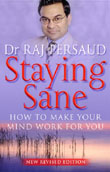 Top Book Top Book Staying Sane by Raj Persaud.
Click here to read review. |

 Inbox Insights Inspirational Quotes, is a new, free, bimonthly email service from Uncommon Knowledge. Each ‘Insight’ contains a classic quote with a brief discussion of it. The Insights are designed to be uplifting, motivational, inspirational and fun. And contain some interesting ideas (we hope!). If you want to sign up, click here.