Can't Sleep? Hypnosis Can Help
Mirroring the natural way you fall asleep, hypnosis is the perfect insomnia cure
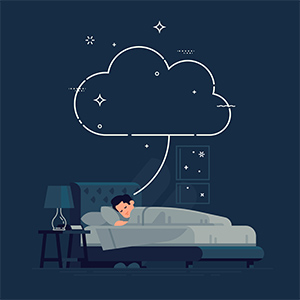 Hypnosis is similar to the REM stage of sleep, which is why it can act as a 'kickstart' to get you to sleep.
"Sleep that knits up the ravell'd sleeve of care,
The death of each day's life, sore labour's bath,
Balm of hurt minds, great nature's second course,
Chief nourisher in life's feast"
- William Shakespeare
You must sleep.
It's 3 am and you've woken up again! Or maybe you haven't even slept at all? Perhaps you can't bring yourself to look at the lousy time. Why can't you sleep?
You feel sleepy, exhausted even! But, like trying to grasp shadows, the closer you get to sleep the more elusive it becomes. And the more you try to sleep, the more you know you must sleep, the further you seem to drive it away.
Sleep is a balm that cures. It is nature's great comforter. And science has proven just how vital sleep is for us.
The pros and pros of a good night's sleep
Perhaps you saw the recent study that showed poor sleep makes you less physically and socially attractive.1 And you've got a crush to impress, dammit! 'Beauty sleep' really is a thing.
Maybe you've also seen the evidence that good sleep tracks alongside being happier and healthier,2,3 or that poor sleep (either not enough or low quality) may shorten lifespan,4,5 damage heart health6 and inhibit thinking ability.7 You might also have seen research showing that terrible sleep makes us more prone to anger and unable to adapt in stressful circumstances,8 and more prone to accidents.9 And to top it all off, lousy sleep also interferes with the body's natural healing mechanisms.10
Undoubtedly you've tried all manner of strategies to sleep better if it's been a problem for you. Hopefully you've cut down on stimulants such as caffeine, and limited alcohol consumption (which we know can worsen sleep quality).11 Maybe you've ditched screen time before bed, which is also a well-known sleep thief.12
Or maybe you've gone down the chemical route. Perhaps you've tried sleeping pills, such as benzodiazepines. But maybe you found that, while they may help you find the unconsciousness you seek, they don't seem to produce the pure benefits of a good and natural night's sleep, such as clear thought and energy the next day. Or perhaps you haven't taken anything because you don't want to get hooked on sleeping pills.13
But have you, I wonder, in those desperate and lonely sleep-deprived wee small hours, evoked the aid of a certain ancient and powerful Greek god?
Why using hypnosis for sleep makes scientific sense
If you'd been around in ancient Greek days and were finding sleep a reluctant visitor, you might have evoked the power of Hypnos - the god of sleep.14 More than merely the god of drowsiness, Hypnos was the heart and soul, the personification, of sleep itself. His name is the origin of the word hypnosis.
Hypnosis does have connections to sleep - but not just any part of sleep.
It seems that when people are hypnotized, they access the rapid eye movement (REM) state of sleep while they are awake. Normally, of course, we access REM when we are asleep, during dreams.
During hypnosis we can still be consciously aware, but the unconscious mind is open to new learning and we can experience deep rest and calm as we do in another stage of sleep: slow-wave sleep.
That great god Hypnos seemed to have something going for him.
Modern researchers have found that hypnosis is an effective aid for getting to sleep sooner and staying asleep;15 for sleepwalking and night terrors in adults16 and children;17 and for parasomnia, a disorder characterized by abnormal or unusual behavior of the nervous system during sleep.18
So perhaps in a way the ancient god Hypnos really is able to help the sleep-starved and -disrupted.
But how can Hypnos - okay, hypnosis - help you sleep better?
What to do when you 'forget' how to sleep
Anyone can tell you that going to sleep isn't a conscious process. One of the great ironies is that we're more likely to fall asleep when we try to stay awake. We seem to drive Hypnos away when we attempt to force him to appear.
When you try too hard to sleep, you can become more awake. Anxiety and worry about sleeping (or anything) drive us further from the godly and comforting arms that carry us sleepily into Slumberland's sweet pastures.
Time and again I've heard the same thing from my chronic insomnia clients:
"It's as though I've forgotten how to sleep!"
What they really mean is that they have become conditioned to respond to the sleep situation (i.e., bedtime) with anxiety or irritation instead of relaxation. Emotion is as much a stimulant as caffeine.
What needs to happen in these circumstances is a 'retraining' of the mind and body to achieve the necessary state for sleep to naturally happen.
But there's another common assumption that I think prevents people finding sleep.
Sleep is a journey as well as a destination
People often assume that in order to drift off to sleep they have to 'switch off'. But actually, as you go to sleep your mind doesn't so much switch off as switch on - but in a different way.
Sleep is not one uniform phenomenon. It comes in different 'layers'.
First, we enter the very initial stages of sleep - a 'hypnagogic' stage in which sometimes we are still consciously aware for a few moments. In this stage we have 'dream fragments' rather than proper, full dreams. This stage is similar to hypnosis.
The tap of rain on the window pane may be magically or metaphorically transformed into the beat of a drum in the mind. The breathing of a partner may become the sound of waves lapping at the shore.
Traditional methods of encouraging sleep, such as counting sheep in the mind, weren't used to bore people into slumber so much as to 'switch on' the hypnagogic first stage of sleep.
Hypnosis promotes this phase, and during hypnosis suggestions are made to go into deeper slumber and sleep fully and deeply. After the hypnagogic, 'dream fragment' phase, we go deeper.
Deep sleep: the wellspring of true rest and energy
After passing through the initial, hypnagogic phase of sleep, we go into 'slow-wave' sleep, so called because of the slow brain waves recorded in deeply sleeping people. These waves become progressively slower as we descend further into sleep. The lightest phase of slow-wave sleep is 1, and the deepest (the slowest waves) is 4.
During slow-wave sleep your immune system is nourished, your body heals, and you become deeply energized and refreshed. Interspersed with slow-wave sleep is rapid eye movement, or REM, sleep. This is when we dream.
Depressed people have more REM sleep, which is far less restful than slow-wave sleep. Too high a ratio of REM sleep to slow-wave sleep is one of the major causes behind the exhaustion so often seen in depressed people.19
It seems that dreaming helps to 'flush out' any unfulfilled emotional arousal or expectation from the day before.20 But flush out too much or too often and you'll eat into the precious, healing slow-wave sleep your body so needs.
We use hypnosis not only to help people get to sleep and sleep for an adequate duration, but to help them have the right composition of REM versus slow-wave sleep.
Using hypnosis for sleep - a summary
Remember, one difficulty with sleep is that the harder you try to sleep, the less likely it is to happen. This means we need to approach it in a different way. Rather than going directly for the goal, we need to 'set the scene' so that natural sleep processes can take place by themselves - as a byproduct of hypnosis.
We use hypnosis to help retrain the unconscious mind to begin to sleep easily and naturally again. Hypnosis promotes the initial stage of sleep, the hypnagogic state, which is the gateway we must pass through before we can fully enter into Hypnos' rich world of natural health and healing.
Get a free hypnosis session with our Sleep Well app for iPhone & Android
Includes our most popular sleep session free, with the option to upgrade to 12 more sessions.
Get the Sleep Well app for iOS (iPhone or iPad) here or for Android here.


References
- https://royalsocietypublishing.org/doi/full/10.1098/rsos.160918
- https://psycnet.apa.org/record/2000-07284-000
- https://www.sciencedirect.com/science/article/pii/S1064748112608628
- https://www.frontiersin.org/articles/10.3389/fnagi.2014.00134/full
- https://www.jstage.jst.go.jp/article/jea1991/10/2/10_2_87/_article/-char/ja/
- https://onlinelibrary.wiley.com/doi/abs/10.1111/j.1753-4887.2007.tb00371.x
- https://www.tandfonline.com/doi/abs/10.1080/13854046.2012.658439
- https://www.ncbi.nlm.nih.gov/pubmed/30359072
- https://ajph.aphapublications.org/doi/abs/10.2105/AJPH.82.7.1011
- https://onlinelibrary.wiley.com/doi/full/10.1111/dme.13780
- https://www.sleepfoundation.org/sleep-topics/how-alcohol-affects-sleep
- https://www.physiology.org/doi/full/10.1152/japplphysiol.00165.2011
- https://www.addictioncenter.com/sleeping-pills/
- Hypnos' Roman equivalent is Somnus, from whence we get the hypnosis-related word somnambulism (sleep walking).
- https://journals.sagepub.com/doi/pdf/10.1177/014107687907201007
- https://www.tandfonline.com/doi/abs/10.1080/00029157.1992.10402853
- https://www.tandfonline.com/doi/abs/10.1080/00029157.1992.10402853
- http://jcsm.aasm.org/Articles/030406.pdf
- See: https://www.lift-depression.com/sleep-depression/why-depressed-people-dream-more/
- See Why We Dream, by Joe Griffin and Ivan Tyrrell: https://www.amazon.co.uk/Why-we-dream-definitive-answer-ebook/dp/B07F8QV181/