How to Overcome Fear
5 psychological understandings that will help you defeat 'the old enemy'
Crazy? Yes.
Because, at this point, I'm more willing to die than to be humiliated. And oh, I am going to die, I'm sure of it. With an agonizing impact, I'll be spattered in a split second. A spectacle of shock, disgust, and, worst of all, pity. What am I thinking? What am I doing?
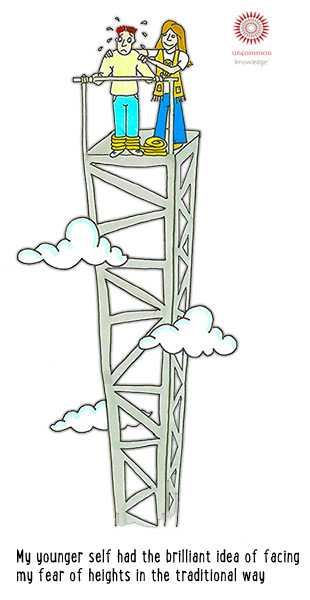
The deafening thumps of my racing heart stand out against the eerie silence of altitude. Sweat drowns my vision and steals the grip from my trembling palms. Two hundred feet of empty space stand before me, mocking me. Taunting me. A wave of nausea passes through me as I prepare to throw myself to my death.
I thought the charity bungee jump would be over water, not unforgiving concrete.
I thought I'd exude calm and grace under pressure, just like they do in the movies.
I was wrong.
"Okay, when you're ready. Just dive." The long-haired surfer dude is observing me with a kind of detached fascination, apparently unperturbed by the situation. But my imagination won't stop.
Do these bungee jump guys even know what they're doing?!
After three different boys (yes, boys - none of them looked a day over 16) had placed different parts of the harness on me, the last guy had frowned. He'd turned to the first guy, tut-tutted like a disappointed math tutor, and all but ripped my Velcro harness off me so he could re-attach it - "safely this time".
I feel about as reassured as an overfed turkey the week before Christmas.
Suddenly it's the moment of sickening truth. I want to cling to the cold crane like it's my giant metallic mother attempting to drop me off at some headline-grabbing school of terrible accidents.
"Okay," says the underaged surfer dude, seemingly oblivious to my despair, "on the count of three, just dive."
"One...
"Two...
"And... THREE!"
I lunge into nothing.
I begin to fall.
But more of that later.
Since that time - well over 25 years ago now - I've treated tens of thousands of people for fear in its myriad manifestations. From Post-Traumatic Stress Disorder to Generalized Anxiety Disorder, I've seen a lot of very scared people. I've helped sufferers of crippling social anxiety, frightened flyers, nervous night owls, and people with every phobia you can imagine and some I bet you can't.
And you know what?
Fear knows no boundaries
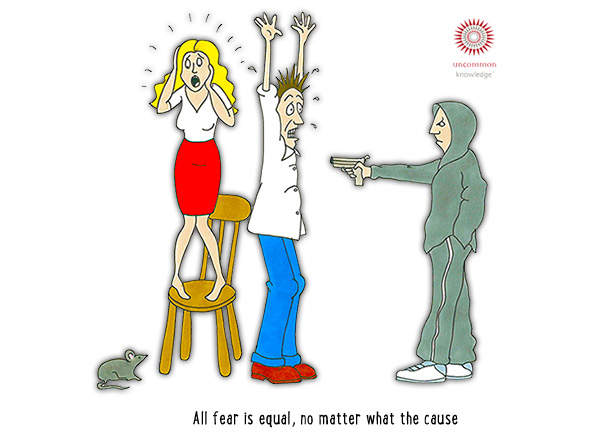
Old or young, rich or poor, man or woman. Fear strikes everyone. I once treated a kidnapped man who believed that at any moment he would be murdered, and a psychiatrist whose patient actually did try to kill her. Yet their fear was no more or less real than that of a woman I helped overcome fear of travelling on trains, or one who dreaded the sight of a plastic button.
This isn't commonly understood. Most people feel a war veteran's flashbacks to battle must be more intense than a severe phobic reaction to plastic buttons. But I'm here to tell you that's not necessarily true. People who have experienced the most intense fear imaginable have been laughed at because others don't appreciate just how horrible that kind of fear is. Because it's difficult - maybe even impossible - to really appreciate how anyone can fear what you don't.
But all intense fear, regardless of what it's focused on, feels the same. I have come to respect all fear, no matter what its focus.
But where does all this fear come from?
Fear - what is it good for?
Let's be clear. Fear isn't a 'condition' - it's a response, just like salivation. We need fear. It is our emergency survival response, our warning sign in the event of a real and immediate physical threat.
Fear becomes a condition only when it gets out of hand and, like an emotional allergy, gets triggered by everyday, non-threatening situations.
And here's another thing about fear that many people don't get.
Fear is not caused by thoughts
Trying to ease fear by thinking differently may help a little. But it's a slow process and, if the fear is really powerful, it won't work. And there's a good reason for this.
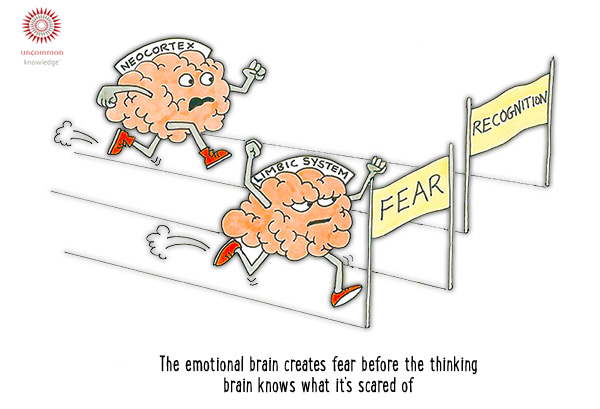
When we respond with a sudden jolt of fear, we do so without thinking. If a bomb goes off near you, your response will be faster than your thoughts. Eventually, you'll think, "That must have been a bomb!" But by the time your thought catches up with your emotion, you're already fleeing. Fear is a super-quick, efficient response that can't afford to be slowed down by thought.
And this is why, for strong fears, just thinking and talking about it isn't enough. Challenging thoughts and trying to forcibly change them in the hope of bringing massive fears into line is putting the cart before the horse. And that's why we turn to hypnosis - to work with people's emotions, not their conscious thoughts.
There are more neuronal connections leading from the 'emotional brain' to the 'thinking brain' than vice versa. What this means is that emotions can drown out thoughts. In fact, it's easier and more powerful to change feelings in order to naturally change thoughts than the other way around. We call this 'emotional hijacking', and it's exactly what happens in a moment of immediate panic.
And fear can attach itself to just about anything, even activities that are crucial to individual or collective survival. An anorexic comes to fear eating; a rape victim may come to fear sex.
To help those in fear we need to know the beast; to understand how fear and anxiety play with the sufferer's mind and pollute their life. That's why, to this day, I'm glad I went through what I did at the top of that crane. Thanks to that experience, I know how fear feels - and I know it can be overcome.
I want to share with you the principles I have found most useful to understand fear, and the techniques that can finally put sufferers' minds at rest.
1. Fear needs a shape
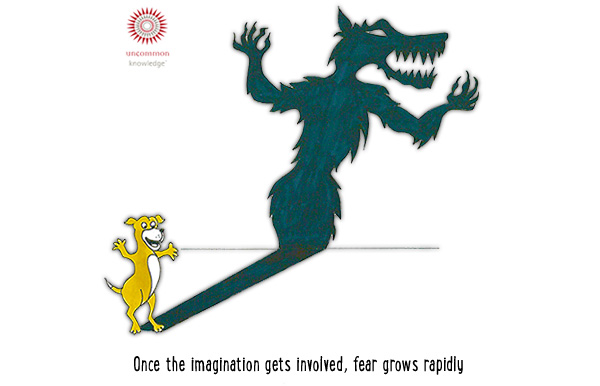
At times we may feel we are almost drowning in fear; as I did all those years ago at the top of the crane of doom. But fear resembles water in another way as well.
Fear, like water, needs a channel, some vessel in our mind, to give it shape.
So if you are feeling anxious, stressed, or fearful but there is nothing actually life threatening for your mind to latch on to, your mind will imagine something for the fear to embody; it will give that fear a form. This explains why chronic worriers seem to worry about anything and everything.
Obsessive thoughts or excessive focus on things you wouldn't normally even think about (often in the wee small hours of a sleepless night!) is really stress driving your imagination to create reasons to justify that stress! The fearful imaginary scenario then produces yet more fearful feelings, creating a vicious cycle of fear and anxiety.
And from there, our imagination takes over and instils what can become seriously long-term fear. Rumi, the 13th-century Persian poet, recognized this:
"It is imagination, blocking you as a wooden bolt holds the door. Burn that bar..."
For centuries, we have known that imagination and fear are closely linked. Let me be clear; when I say 'imagination', I'm not suggesting that people's fear is not real. Only that any fearful feelings that occur outside of an actual situation of current and immediate danger are processed through the imagination.
A war veteran with Post-Traumatic Stress Disorder (PTSD) is fearful of something that was real in the past, but doesn't exist in the present. But they still experience moments of pure terror (flashbacks) in completely safe situations. Those flashbacks are so real to them because they are processed through their natural 'reality simulator' - their imagination.
So what can we do about this?
Why hypnosis helps
Trying to treat fear just by trying to get people to think differently without first dealing with the feeling part is like trying to deal with earthquake damage by papering over the cracks. That's why hypnosis can be so helpful in treating anxiety and fear conditions. Learning to control the imagination, linked as tightly as it is to emotion, is what therapeutic hypnosis is all about.
Good hypnosis should enable you to master the option of not buying into fearful thoughts or automatic 'post-hypnotic' fear reactions. The clinical use of hypnosis is all about constructive use of the imagination, as opposed to the destructive role it plays in fear. Fear is a kind of trance state in which the person experiencing it is totally focused on that fear (to the point where they may not even notice elements of reality outside that focus). Here's what I mean.
2. Fear is an hypnotic trance
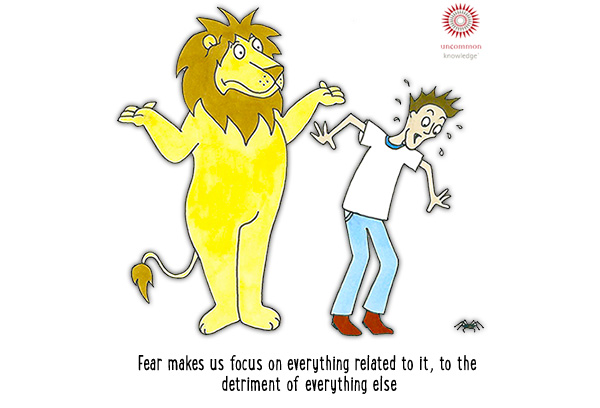
When we are fearful we are focused. The spider phobic may focus out everything other than the offending eight-legged terror scuttling around their kitchen. They are hypnotized by their fear. For a while, it's as if they can't hear or see anything that's not connected to that fear. And during that fear trance they become so suggestible that, unconsciously, they learn even more deeply. In future, they may automatically fear not just spiders but even entering their kitchen, because they now have a strong association between being in that room and feeling sick with terror. The kitchen is now acting as a kind of post-hypnotic trigger to automatically stimulate fear.
This post-hypnotic trigger aspect of fear happens in people with all kinds of fears. And it is clear evidence that fear and anxiety are not 'thought disorders'. Fear precedes thought because it has to: it is our first line of defense for survival.
Why hypnosis helps
Using therapeutic trance to quickly treat maladaptive or pathological trance states such as excess fear makes sense. If we can tap into the part of the mind that maintains fear, then we can update fear responses quickly and effectively. And that's exactly what hypnosis does.
Working with that spider phobia, for example, we can use carefully applied hypnosis to both ease the memory of seeing that spider in the kitchen and change the association of fear to one of comfort, so the kitchen now feels safe. And here's another really encouraging way to think about fear.
3. Fear learns
Fear is a great motivator. The trouble is, it can motivate you away from things that would actually be great for you! One way to think of your fear instinct is as a poorly trained dog. When you train a dog, you work with their instincts - and fear is no different.
Ever noticed how anxious dogs often seem to have anxious owners? It's important to remember that your instincts, like a dog, take your lead. They learn by how you feel when you do something, and the level of arousal you feel when you imagine something.
So if you avoid a situation through fear, your fear instinct will infer that the situation is life threatening, and will try to help you out by reinforcing that fear. Your poor old fear instinct doesn't know that asking someone on a date or going for an interview isn't life threatening. It's just getting that impression from how you behave and what you imagine when you think about these things. And this is great news! Here's why.
4. Fear is trainable
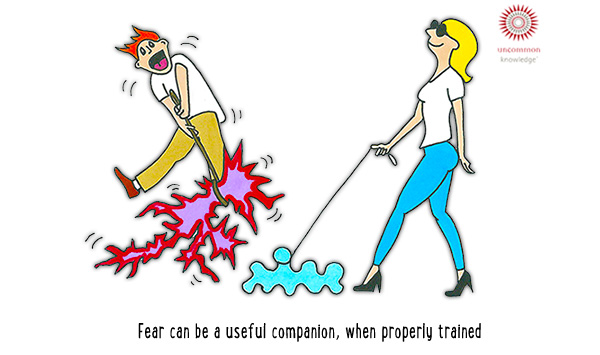
As all bomb disposal experts know, fear is trainable. If you make yourself repeatedly and calmly do something that actually is life threatening, your fear instinct will gradually diminish until it completely switches off around that activity. It's like your instinct works out that it can't be that threatening, or you wouldn't voluntarily do it. This is why circus performers can be calm while putting their head in the lion's mouth or getting fired from a cannon. (Not that I recommend this!) The point is, if you voluntarily do something dangerous, your fear will tend to diminish.
In my case, my second bungee jump, a year later, was comparatively easy. Had I refused to jump the first time I may have never gone back to it. But when the first experience didn't end in death, my fear response reduced just enough to give me the confidence - or stupidity! - to do it again.
Up until now I've been talking about fear as though it's just a psychological response. But as anyone who's experienced it will know, it's far more than that.
5. Fear is a full body reaction
Far from being 'all in the mind', fear involves your entire body. Every system, every organ, perhaps even every cell. It narrows your focus mentally, but it also rapidly alters physical processes in your body.
One of the first things to switch off when your fight or flight response kicks in is salivation, because you don't need to be eating if you're busy trying not to be eaten. What's interesting is that this association also seems to work in reverse.
Your fear takes the lead from what your body is doing. When you salivate, your fear instinct decides all must be well - if you can salivate, the environment must be safe enough for you to be able to eat. There's no need to be fearful. Your fear starts to dissipate, and this stimulates a domino effect where all the other symptoms of fear lessen as well.
Some people have learned, perhaps with little conscious awareness, that chewing gum helps them feel calmer. What they probably don't realize is that it's all because it stimulates salivation.
This same principle is at work during the immensely powerful 7-11 breathing technique. Deliberately breathing as you do when you're relaxed gives your nervous system the message that it doesn't need to be fearful.
But there's a much better way of reducing fear levels without having to force yourself back into a situation while you are still fearful.
Why hypnosis helps
If you feel anxious when you think about an upcoming situation, whether you realize it or not, you are effectively misusing self-hypnosis and building an unhelpful association.
What if, instead, you used self-hypnosis to build a helpful association? This is the guiding principle behind overcoming fear. Rather than exposing yourself to a feared situation in real life, imagine yourself feeling calm in that situation. It's comfortable, quick, and it trains your instincts to automatically respond to the situation with calmness in future.
And the best way to do this is through your imagination during hypnotic trance.
As I've said, your instincts are shaped not only by your actions but also by your imagination and the way you feel when you imagine something. If I'd known about hypnosis before my first bungee, I could have primed my fear instinct beforehand by hypnotically rehearsing the jump while feeling very calm and relaxed. And while the bungee jump was not something I had to do, public speaking was. And hypnosis helped me overcome my fear of that in one session. The effect has lasted 20 years so far, and I can't see it wearing off any time soon.
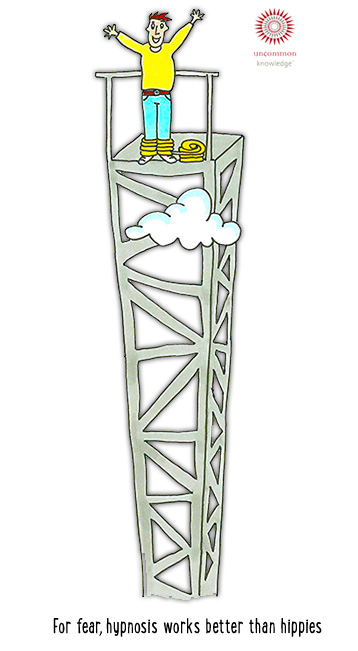
Now, if I have a challenge coming up, I close my eyes, enter deeply relaxed hypnosis, and then - only then - I imagine myself in that upcoming situation. In this way, I'm effectively setting a helpful instinctive blueprint for the situation.
Once I have self-hypnotized a few times and have really strongly visualized that event while feeling very calm, it becomes hard not to feel relaxed during the actual challenge. This is because your instincts don't distinguish between what you imagine and what you experience.
When you imagine a future event, you are using self-hypnosis - whether you intend to or not. Your imagination gets in on the act and your emotions can start to amplify, even to become unhinged from reality. The emotions you feel while imagining the situation become glued to the situation itself. And through repetition, that glue turns into superglue.
It's just a matter of gluing the situation to the right emotion.
The final word on fear
Let's recap:
- In your fear state, any input from your imagination is taken as real evidence. You believe whatever your imagination conjures. Fear thrives on the use - or should I say misuse - of your imagination. The strongest way to use your imagination is through hypnosis, and that's why we can describe people as being 'hypnotized' by their fears. Thankfully, we have better uses for hypnosis!
- Because fear is an hypnotic trance state (your focus is greatly narrowed), it is also a learning state. The unconscious mind can learn to produce a 'post-hypnotic' response to any triggers that even slightly remind it of the original fearful situation.
- Fear is like a guard dog - it needs to be trained so that it only acts in the rare situations it's actually needed.
Back at the crane...
I'm too terrified to even close my eyes. The concrete speeds towards my face, and I steel myself for the impact. But then something amazing happens. The cord hasn't broken. I'm alive!
I was terrified of heights for a while after that. Suffice to say it was a very focused experience! Not that I understood what that meant at the time. Back then I didn't know about hypnosis, and I suffered vertigo for a year afterward.
When I forced myself to do another bungee jump a year later, I overcame my induced fear of heights through brute effort. But it would have been so much easier and more comfortable had I known what I know now about hypnosis!
If you're suffering from fear and anxiety, subscribe here to receive my free fear and anxiety tips emails .
Related: Anxiety Treatment Category