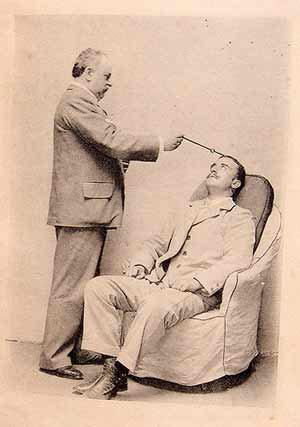
Hypnotherapy techniques are a fast effective and natural way of helping people feel better
As a therapist (unless you’re a hypnotherapist), here’s something you may not have heard before:
Hypnosis happens in all therapy.
One characteristic of the hypnotic state is abstraction. By that I mean physically being in one place but psychologically being in another.
This happens to a profound degree when we dream at night. Physically you’re in bed, but psychologically you’re somewhere else.
Prefer to watch instead?
Fish asking what water is
Consider counselling. The counsellor may regard hypnosis as ‘a no go area’ for their depressed client, even as they start asking the client about their life and their past. But as soon as you ask a client questions relating to realities outside the therapy room, you are inviting them to ‘trance out’.
When the client becomes more psychologically tuned in to – say – the divorce they went through last year than to the right here/right now therapy room, then the ‘abstraction’ element of trance is in full play.
This type of hypnosis is so familiar to us all that it’s easy to conclude that, well… “It’s not really hypnosis!”

FREE Reframing Book! Just subscribe to my therapy techniques newsletter below.
Download my book on reframing, "New Ways of Seeing", when you subscribe for free email updates
3 core hypnotherapy techniques that use the mind’s subtle power
1. Bring back the good times with hypnotic visualization
The first way you can usefully and naturally use hypnosis (and remember, if you are a therapist you are using it anyway!) is to focus people’s attention on times they’ve felt really good. Once you’ve done that, you can use those good feelings as a bridge to therapeutic gain (without any pain).
Hypnosis doesn’t just happen when we close our eyes. You can easily become more attuned with your memories or fantasies than with your immediate surroundings even with your eyes wide open.
So you might begin by asking someone to describe the last time they felt good/relaxed/joyful/interested – or just ‘okay’.
Now ask for a description of those feelings. What words would the client use to describe them? (e.g. ‘lightness’, ‘energy’) You can then suggest that, as you talk, they can begin to notice those very feelings developing in their body. You could suggest that certain great memories come to mind or, if memories are associated with loss, you could suggest that as those feelings develop, certain positive images ‘from the future’ will come to mind.
This really isn’t so different from asking someone to recount how they felt during a past upset!
Recently I worked with a woman who found it difficult to feel as ‘good as the other mothers’ when collecting her daughter from school. I helped her recall a time when she felt strong and relaxed. Then I got her to ‘keep those feelings’ while she strongly visualized picking her daughter up at the school gates. Hypnotherapists just extend what all therapists do when they ask clients to talk about their lives.
For more technique demonstration videos, see Uncommon Practitioners TV
2. Use post hypnotic therapy – build positive expectation
We’ve all seen (or heard about) stage hypnotists using ‘post hypnotic suggestion’ – for example, “When I click my fingers, you’ll sing like a canary!” But post hypnotic suggestions happen all the time, to all of us.
A soldier is traumatized by a bomb blast in Afghanistan. Months later, he’s back home and a car backfires – working as a natural post hypnotic suggestion to feel terrified, just as he did during the initial explosion. PTSD is post hypnotic suggestion working pathologically.
Placebo, in which someone believes, for example, that a white sugar pill is a powerful antidepressant and so recovers from depression, is also a form of post hypnotic suggestion.
The moments when expectation is created within the mind are hypnotic moments.
Making positive expectation statements to your client when they are focused enough to hear them and register them can be hugely therapeutic:
“And you can be curious as to just how this confidence is going to manifest next time you’re at the school gates…”
“It’s a strange but amazing feeling the first time you wake up in the morning and realize you actually feel compelled to start the day…”
Use positive expectation because it’s hypnotic.
3. Use hypnotic phenomena to demonstrate that they can change
During hypnosis it’s quite easy to produce phenomena such as hand levitation, time-distortion and numbness. Experiencing this kind of thing can powerfully demonstrate to the client that they can do things they ‘didn’t know they could do’.
For example, I taught one man to repeatedly ‘switch off’ feeling in his hand by visualizing it packed in ice, then switch sensation on again. I linked this to his public speaking anxiety and suggested that, if he could switch off physical sensation so easily then switching off public speaking fear would be a ‘right doddle’. That means ‘easy’ in British-speak.
Whatever you call it, his speech was a success!
Click here to read about my online training course Uncommon Hypnotherapy
FREE Reframing Book! Just subscribe to my therapy techniques newsletter below.
Download my book on reframing, "New Ways of Seeing", when you subscribe for free email updates

About Mark Tyrrell
Psychology is my passion. I've been a psychotherapist trainer since 1998, specializing in brief, solution focused approaches. I now teach practitioners all over the world via our online courses.
You can get my book FREE when you subscribe to my therapy techniques newsletter. Click here to subscribe free now.
You can also get my articles on YouTube, find me on Instagram, Amazon, Twitter, and Facebook.