
Getting to the root of the problem can sometimes be surprisingly simple
The other day, I was sitting in a pub waiting to have lunch with a friend who’s something of a ‘petrol head’ (or ‘gear head’).
He finally appeared half an hour late, flustered and apologetic. “Sorry I’m late! My car died.”
Though I know little about fixing cars, I asked, “Oh? What was wrong with it?”
“Well, it’s the weirdest thing!” he said. “I checked the ignition switch, made sure the timing belt hadn’t broken, double-checked none of the spark plugs were loose…”
My attention started to drift as he rattled off a seemingly interminable checklist. Nevertheless, I couldn’t help noticing that something that seemed obvious even to me got left off.
Prefer to watch instead?
Certain I was about to be mocked for asking a silly question, I ventured:
“And you’re sure there was petrol in the tank?”
He stared at me for a moment, dumbfounded, before burying his face in his hands with a groan about his son, who was notorious for not refuelling, having borrowed the car the night before.
How easy it can be to miss something that later seems all too obvious!
To function well, basic needs must be met
If we’re not careful, we practitioners can make this same error of overlooking the obvious in pursuit of ‘digging for the root of what’s wrong’ with our clients.

FREE Reframing Book! Just subscribe to my therapy techniques newsletter below.
Download my book on reframing, "New Ways of Seeing", when you subscribe for free email updates
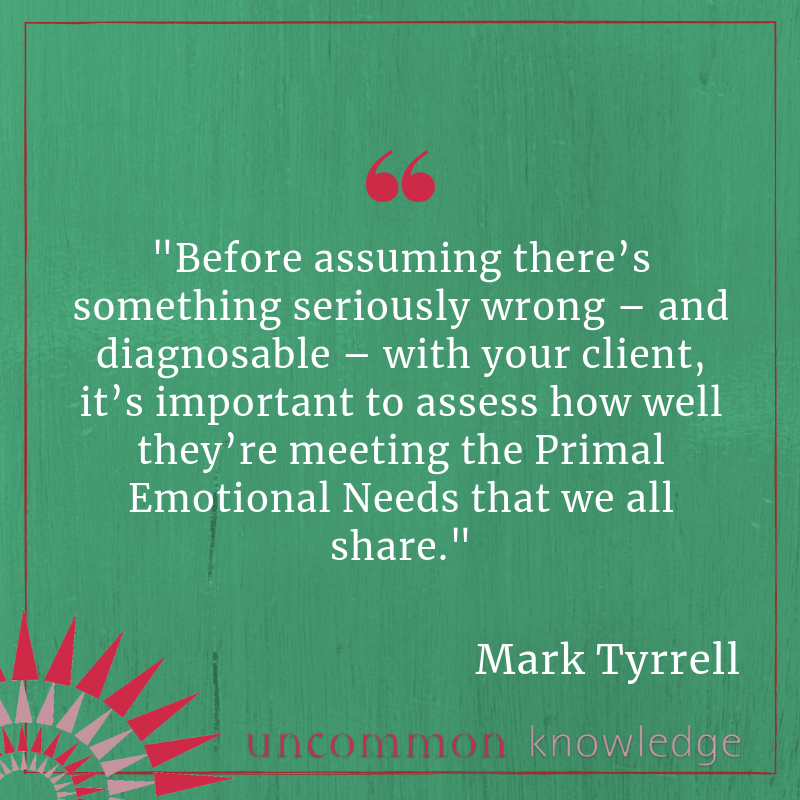
Before assuming there’s something seriously wrong – and diagnosable – with your client, it’s important to assess how they’re meeting the universal Primal Human Needs we all share.
Because in addition to our physical needs like food, water, and shelter, every one of us has a number of emotional needs:
- To give and receive attention
- To heed the mind/body connection
- For purpose, goals, and meaning
- For community and making a contribution
- For challenge and creativity
- For intimacy
- For control
- For status
- For safety and security.
When these needs are not adequately met, we fall prey to all kinds of emotional disorder, from depression to addiction. This is due to an often unconscious attempt to satisfy the needs somehow.
When these needs are met well, we feel fulfilled and contented. We also have more ‘spare capacity’ to focus on long-term goals and our responsibilities.
Check your clients’ fuel levels
When you look at life from this perspective, it’s easy to see how much negative impact not having these needs met over an extended period can have on people’s lives.
You also start to notice how every form of human cruelty, from workplace bullying to political tyranny, involves blocking the meeting of one or more of these needs.
So, unless we get a sense of how well these needs are being met in a client’s life and address any deficits, our attempts to help them risk being no more than tinkering with symptoms (be they smoking, chronic drinking, depression, or something else).
For more quotes, follow Mark on Instagram
But how do we assess how well the Primal Human Needs are being met?
‘Small talk’ can yield big discoveries
Simply asking general questions in the natural flow of conversation is an elegant way of ascertaining someone’s lifestyle health.
To the client, this may seem like no more than ‘small talk’. But if you encourage them to talk about their lives, just listen, and pay attention. Your small talk can reveal a great deal about their overall welfare.
Of course, you don’t want the therapy session to become an interrogation and you should feel free to come up with your own questions. But if you need some inspiration, these sample questions are the kind you can slip into the conversation to elicit answers specific to certain needs:
- How often do you get to meet up with friends? (attention, community)
- Can you and your partner really talk together? (attention, intimacy)
- How are you sleeping these days? (mind/body connection)
- Are you happy with your diet? (mind/body connection)
- How much exercise are you getting? (mind/body connection)
- Is there anyone who you feel really understands you and is close to you? (intimacy)
- What choice do you have about what happens in your life? (control, security)
- Do you have a clear sense of where you want to take things in life? (meaning, purpose)
- Do you feel excited by stuff in your life? (challenge, purpose, meaning)
- What involvement do you have with people around you? (community, status)
Because if we don’t or can’t gauge the extent to which these universal and timeless – that’s why they’re ‘primal’ – human needs are being met, then we may end up like my friend who tried everything else to get his car to start but never checked to see if it had any fuel in the tank.
FREE Reframing Book! Just subscribe to my therapy techniques newsletter below.
Download my book on reframing, "New Ways of Seeing", when you subscribe for free email updates

About Mark Tyrrell
Psychology is my passion. I've been a psychotherapist trainer since 1998, specializing in brief, solution focused approaches. I now teach practitioners all over the world via our online courses.
You can get my book FREE when you subscribe to my therapy techniques newsletter. Click here to subscribe free now.
You can also get my articles on YouTube, find me on Instagram, Amazon, Twitter, and Facebook.