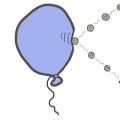
"A diamond doesn't know its own worth" is a powerful way to subtly challenge the client who feels worthless
You’re walking along a busy road when you spot a sweet old lady on the other side who needs help to cross the road.
Do you:
A) Shout and wave her over from your side, hoping she’ll dodge the racing traffic and roaring buses?
or
B) Cross over, join her on her side, and then gently lead her safely to where she really wants to be?
Prefer to watch instead?
Arguing with strong beliefs
One thing you might have found in your therapy work is that no matter how factually based a compliment is, a client with low self esteem seems to find a way to dismiss it.
You: “I’m impressed you were promoted twice in one year! You’re clearly a hard worker!”
Client: “Oh, that was just dumb luck. I suppose my boss felt sorry for me.”
It’s really frustrating, but there’s a good reason why people with low self esteem do this.
Low self esteem is a highly emotionally charged belief. And contradicting any belief, however well-intentioned and even logical your argument, will likely be met with strong resistance.
Two important research findings help explain why this is:
- People with low self esteem are more likely to have been abused and bullied in the past, so their low self esteem beliefs have been forged through intense emotion (1). And you can’t logically argue someone out of an emotionally driven belief.
- The famous (and much lauded) ‘positive affirmation’ may actually worsen low self esteem (2). So if they’ve been doing this, they will be feeling worse!
That’s why trying to contradict a client’s powerful belief system that they are ‘worse than others’ or ‘unlovable’ by telling them how special or wonderful they are is akin to trying to wave the old lady across the busy road. To them it seems an impossible (and dangerous!) distance.

FREE Reframing Book! Just subscribe to my therapy techniques newsletter below.
Download my book on reframing, "New Ways of Seeing", when you subscribe for free email updates
So how do we change a client’s negative view of themselves, if high emotion is clouding the logical truth?
Working with low self esteem can be hard. Here are 3 crafty techniques that (subtly) challenge the hold it has on your therapy client.
1) Agree – and then disagree
Agree with the part of what they have said that you can agree with. Then gently put a more positive spin on it:
Client: “I am just a waste of space! I’m a lousy mum!”
You: “You’re a waste of space? Well, that’s what you believe, [agreement] but I’m happy that you’re taking up space here. In what ways do you want to improve as a mum?”
Note how this isn’t so overly positive as to be an instant turn-off and how using the word ‘improve’ implies that ‘lousy mum’ is not a fixed state and that things can change positively. There is no outright contradiction.
2) Use metaphor to bypass conscious argument
Metaphorical language allows you to present a positive pattern to someone without directly contradicting their beliefs.
For example:
Client: “I just feel so worthless!”
You: “Yes, it can be difficult to see your own worth for what it truly is, can’t it? A diamond, for instance, has no sense of its own amazing value and a beautiful painting can’t possibly know its own beauty…”
There is no direct challenge to their statement. You might now quickly change the subject so the idea can work subconsciously, undisturbed by the usual ‘automatic negative filter’.
3) Reframe negatives as positives – but carefully!
Context is everything. A knife in the hands of a mugger is a very different thing from a knife in the hands of a surgeon. Find the positive quality in any ‘deficit’ and gently turn it into a positive. For instance:
Client: “My husband says I’m stubborn.”
You: “Mmm… and in what other ways do you show that kind of determination?”
No matter how good our intentions are, trying to wave the little old lady across the street doesn’t work. Instead, we therapists need to gently guide our clients across the road and onto a happier future.
How to Lift Low Self Esteem in Your Clients is my online course in how to tackle even the most desperate of cases of poor self worth. Read more here.
FREE Reframing Book! Just subscribe to my therapy techniques newsletter below.
Download my book on reframing, "New Ways of Seeing", when you subscribe for free email updates

About Mark Tyrrell
Psychology is my passion. I've been a psychotherapist trainer since 1998, specializing in brief, solution focused approaches. I now teach practitioners all over the world via our online courses.
You can get my book FREE when you subscribe to my therapy techniques newsletter. Click here to subscribe free now.
You can also get my articles on YouTube, find me on Instagram, Amazon, Twitter, and Facebook.


Notes:
- See the Joseph Rowntree Foundation report: Self-esteem: The costs and causes of low self-worth by Nicholas Emler. 28 November 2001.
- Canadian researchers found those with low self esteem actually felt worse after repeating positive statements about themselves. They said phrases such as “I am a lovable person” only helped people with high self esteem. Wood, J.V., Perunovic, W.Q., and Lee, J.W. (2009). Positive Self-Statements: Power for Some, Peril for Others. Psychological Science, 20(7):860-6. DOI: 10.1111/j.1467-9280.2009.02370.x