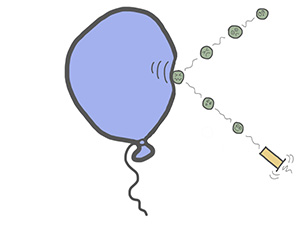
Like peas off a balloon, if the mind isn't 'open' then ideas bounce off
“Can you keep a secret? This has got to stay between us because it’s pretty wild… but you won’t BELIEVE what I found out about Shirley in Accounts!”
I don’t like to think of myself as a gossip, but I must admit that when I heard the woman next to me on the train say that to her colleague, my attention leapt from the sensible book I had been reading and to their conversation.
Very quickly, I got wrapped up in the adventures the free-spirited Shirley had allegedly enjoyed that weekend.
My instant, almost unconscious, shift in focus got me thinking about the power of attention and a workshop I ran many years ago…
Prefer to watch instead?
Bouncing peas off balloons
When we trained therapy students face-to-face, we used to run a curious exercise.
We gave one set of bemused students inflated balloons and another set dried peas. The second group were then asked to throw their peas at the balloons. Eventually…
“Aha! The peas are just bouncing off!”
Rather than just telling the students that suggestions and reframes can ‘bounce off’ the mind of a client who’s not truly receptive, it was far more effective to have them demonstrate it to themselves.
So how can we therapists increase the chance that the pea will stick and not bounce off?

FREE Reframing Book! Just subscribe to my therapy techniques newsletter below.
Download my book on reframing, "New Ways of Seeing", when you subscribe for free email updates
You’re not going to believe this!
Well, there are many ways to get people to open themselves wide to new learning.
One way is to mimic how this normally happens in everyday life, outside the therapy room.
Think about it. What makes you really listen to what’s coming next?
I found myself almost going into trance just listening to two strangers gossip on the train, because I had (over)heard that the story coming was so wild it had to be kept secret.
So, how do you feel if someone says:
Look… I really don’t know how to tell you this… promise you won’t be angry?
Pretty intrigued, I imagine! There’s no way you’re going to leave without hearing the whole story.
Or how about:
Err… I’m not supposed to tell you this, but…
Would you mind if I share something with you? No one else knows… you won’t tell anyone, will you… ?
Can I ask you a personal question?
Of course, if someone talks like this all the time, it won’t have the same impact.
But, generally, this kind of attention-grabbing opening gambit is pretty compelling, leaving us feeling or saying, “What? What?!”
Openers like this create a readiness to listen very closely indeed and can work like mini hypnotic inductions in that they switch us directly into ‘receive mode’. And hypnosis is a powerful way of opening people to learning, which is why we use it.
Now, how do we use this idea in the therapy room to get our clients to pay attention?
Gossip therapy? Really?!
Of course, I’m not suggesting you gossip with your clients just to get their attention.
But if you have an idea or suggestion you feel is really important for your client to hear (and truly hear), then you can preface it with statements just as compelling as those above.
Three examples of attention-grabbing language techniques:
- I have been thinking long and hard about your situation. I don’t know how you’re going to respond to this, but I’ve decided to tell you something… (leading in to your therapeutic idea or suggestion)
- Listen, can I ask you a question? (of course, you just did, but prefacing your real question with a request for permission tends to stop the person in their tracks and get them wondering what can possibly be coming next)
- This might seem a little personal… and I really don’t want to be intrusive… but… (what you come out with doesn’t have to be particularly personal, but you have now set them up to really listen to what you have to say next)
Therapeutic communication is not a separate world far from everyday, natural interaction.
We can learn to use the patterns of compelling communication strategies from everyday life and harness them to make a difference to our clients.
At least, that’s how I justify it when I catch myself shamelessly eavesdropping!
FREE Reframing Book! Just subscribe to my therapy techniques newsletter below.
Download my book on reframing, "New Ways of Seeing", when you subscribe for free email updates

About Mark Tyrrell
Psychology is my passion. I've been a psychotherapist trainer since 1998, specializing in brief, solution focused approaches. I now teach practitioners all over the world via our online courses.
You can get my book FREE when you subscribe to my therapy techniques newsletter. Click here to subscribe free now.
You can also get my articles on YouTube, find me on Instagram, Amazon, Twitter, and Facebook.