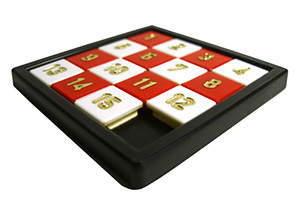
Helping clients escape double binds often involves working on a different part of the puzzle
Imagine you’re a bomber pilot and you’re told that you don’t have to fly dangerous missions if you’re ‘mentally unstable’ (read: crazy). That all you have to do is say.
But by saying, you show yourself to be sane enough not to want to endanger your life, so you have to fly those missions because you’re not crazy!
You might recognize this as part of the book that gave the English language the term ‘Catch-22’, when you’re ‘damned if you do and damned if you don’t’.
Prefer to watch instead?
But while some ‘double binds’ or ‘no-win situations’ are perfectly real, a great many are psychological constructs. That is, clients can think they are caught in a double bind when they’re not.
How double binds tie emotional problems in place
A man who is bored and stagnant in his job may be too afraid to make a change. If he stays, he suffers; if he leaves, he believes he’ll suffer. So he feels stuck.
A woman wants to end her guilty affair but fears she’ll remain unfulfilled in her marriage if she does.

FREE Reframing Book! Just subscribe to my therapy techniques newsletter below.
Download my book on reframing, "New Ways of Seeing", when you subscribe for free email updates
A man wants to have sex but fears he will be ‘unable to perform’ and so avoids all sexual contact.
Such apparent double binds are at the heart of so many emotional and psychological problems. Escaping (or helping our clients escape) a double bind requires:
- Flexible thinking
- A capacity to see beyond the obvious
- A willingness to forgo either/or limitations.
Here are 3 ways we can help our clients free themselves from the double binds trapping them
1. Look for the pay-off
Some people really do feel stuck, of course, but we should bear in mind that people can get accustomed to feeling like this, which has a paradoxical effect. Even discomfort, if it is very familiar, can feel strangely comfortable. ‘Better the devil you know…’
And if I really am damned if I do and damned if I don’t, then that kind of lets me off the hook a little, doesn’t it?
“I’m overweight because of my genes” could, perhaps, be a rather convenient double bind. Is the person getting an emotional pay-off through being ‘allowed’ to feel as if nothing can be done?
Ask your client in detail about all the benefits they’d imagine they’d have if the problem disappeared. If they struggle to think of any but still keep on about how they are trapped, it may be that, consciously or unconsciously, they want to remain stuck.
This doesn’t mean you can’t help them, of course, but it does mean you’ll at least know where you are starting from.
2. Compromise
A man who desperately needed more social contact was too fearful to go out to parties. So he was encouraged to go to an event for only ten minutes and then leave, making the excuse that he had another engagement to attend.
He found that once the pressure was off, he stayed for three hours!
If we stop seeing problems in an all-or-nothing way, we will often find the beginnings of a solution.
Another typical double bind is being very anxious to sleep but finding that the desperate desire for sleep drives sleep away. Untying this bind may be achieved through setting your client the paradoxical task of staying awake until a specified time – or even all night.
Then staying awake becomes the goal, the pressure to sleep is off, and they will be more inclined to sleep.
There is always a compromise, always a third way of looking at a situation (and usually many more!).
3. Change one part of the pattern
If you’ve ever played one of those sliding tile games (you know, the one with the single gap where you have to try to make the sequence or picture), then you know that to change one part of the pattern you first have to work on another part of it.
Helping your client feel differently about an apparent double bind will, in itself, constitute an escape from the claustrophobic prison of a ‘no-win’ situation.
Alternatively, rather than trying to tackle the whole situation in one go, we can just seek to make a start with a small alteration.
For example, a woman who wanted to quit smoking but feared putting on weight was encouraged to learn about the right type of nutrition to stay slim once she had stopped. She then made these changes to her diet and style of exercise before she quit.
In this way, one part of her life’s pattern altered so that other parts (such as the smoking) now had room to shift. Just like our Solitaire board.
We can’t always choose what happens to us, but we can choose – or at least alter, to some degree – how we respond to the variations in life’s rich pattern.
To learn more about flexible thinking and other ways to look at situations, join me on the Conversational Reframing course.
FREE Reframing Book! Just subscribe to my therapy techniques newsletter below.
Download my book on reframing, "New Ways of Seeing", when you subscribe for free email updates

About Mark Tyrrell
Psychology is my passion. I've been a psychotherapist trainer since 1998, specializing in brief, solution focused approaches. I now teach practitioners all over the world via our online courses.
You can get my book FREE when you subscribe to my therapy techniques newsletter. Click here to subscribe free now.
You can also get my articles on YouTube, find me on Instagram, Amazon, Twitter, and Facebook.