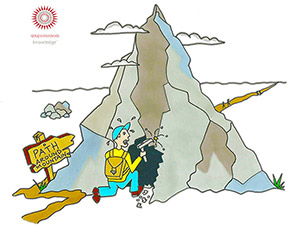
Sometimes we have to find roundabout ways to get where we need to be
Halfway through our first session, I was so frustrated I felt like asking my client Harry to leave.
I’d offer a strategy to help him quit smoking: “You know, many of my clients have found that…” And almost before I could finish my sentence, he’d retort with a head shake, “No, that won’t work for me, I know it.”
“So, you’ve found that you feel the urge to smoke more when the stress is high at work?” I asked, summarizing what he’d said earlier, only to be met with another head shake. “No, Mark, I feel more like smoking when I have a lot of work to do and meetings that day at the office.”
Even when it came time to do the hypnosis part of our session, Harry initially stayed alert and couldn’t – or wouldn’t – relax.
Prefer to watch instead?
This was quite early in my career and I hadn’t yet encountered much resistance – clients who didn’t at least attempt to engage with my therapeutic interventions. I took a few calming breaths of my own to resist an increasing desire to push Harry out the door – or perhaps the window.
And then I suddenly found myself thinking about aikido, a martial art I’d studied in the past.
Therapeutic martial arts
If someone pushes you, should you push back?

FREE Reframing Book! Just subscribe to my therapy techniques newsletter below.
Download my book on reframing, "New Ways of Seeing", when you subscribe for free email updates
Rather than resisting the force of your opponent’s energy and conflicting with it, you direct it and ‘help’ them… well, become more closely acquainted with the mat. But we can do this in therapy by working with our clients’ resistance to help them rise above what’s troubling them.
There is a risk that we might see clients as being ‘resistant’ when they are just disagreeing with us, but Harry was quite clearly pushing back against everything I offered. So I had to figure out how to pull.
Here are 3 things I did that can help you also deal with resistance in your clients
1. Don’t take it personally
It’s perhaps natural to find yourself becoming exasperated or frustrated, as I was with Harry, when your client seems to balk at everything you say.
But when I stopped to think about how to make progress in that session, I realized I could see this kind of behaviour as an opportunity and a bonus.
Why? Because resistance, whatever it’s focussed on, is energy (just like that pushing and pulling) and all energy and motivation can be managed and used in therapy. (I’ll talk more about this in Tip 3.)
When I relaxed and stopped ‘pushing’ against Harry’s resistance, I was able to figure out how to redirect his energy and we started making progress.
So the more relaxed, detached, objective, and calm you can be when a client demonstrates contrariness, the more effective you’ll be in helping them.
2. See what’s behind it
One way to help yourself feel more objective about what seems to be resistant behaviour is to understand what may lie behind it.
People display resistant behaviour for various reasons, including:
- Habit – They may live with someone with whom they are in constant conflict. Or perhaps they work in or were brought up in an environment in which they have/had to constantly ‘fight’ and they haven’t yet settled into a non-conflicting role.
- Status – They may have an unsatisfied (but unconscious) primal human need for status and see every interaction as a tussle for supremacy. If this is the case, we may need to ensure that they feel this need is met before we can get down to other therapeutic work.
- Anxiety – They may be seeking a sense of security and control through insisting on having everything on ‘their’ terms and may be coming across as a control freak.
Harry was working in an underappreciated role he felt over-qualified for in a company that was threatening to lay people off, so it was understandable that he’d feel somewhat anxious about his future and ability to gain status!
Appreciating that there is always something behind the resistance – whether it’s anxiety, out-of-control competitiveness, or merely the habit of contrariness – means you have a chance of handling it effectively, rather than just emotionally reacting against it by becoming upset or angry yourself.
3. Use the resistance
In fact, don’t just use it. Positively encourage it!
If you read the case studies of the psychiatrist Milton Erickson, you’ll see that, time and time again, he encouraged the ‘resistance’ of his patients, seeing it not as a problem but as a vital energy that could, if properly directed, actually help the client.
This is a core principle on our ‘How to Stop Anyone Smoking’ course, where we show video footage of a woman telling me she is “trying not to resist the hypnosis”. I ask her not to try to be more compliant, but to try to “resist even more!” I then go on to talk about how ‘hypnotic’ cigarettes can be and how she can really ramp up her resistance to those ‘hypnotic’ cigarettes.
We actually want our clients to be resistant – but only to what is really undermining them.
So, a chronic smoker’s or drinker’s resistance needs to be encouraged, harnessed, and then directed towards what has been destroying them. Not the therapist, the therapy, or change itself but the cigarettes and the booze.
Recognizing that Harry tended to see things in terms of a tussle, I redirected my aim of relaxing him by suggesting:
“Now, I don’t want you to relax too quickly…”
Now that I seemed to be saying “don’t relax too fast”, if Harry was to continue to resist me, he’d need to relax quickly! And he did. Within moments, his eyes closed and he started to settle down into the hypnotic state where we’d be able to address his smoking more effectively.
Because as Milton Erickson said on the subject of effective trance induction – which, really, can be applied to all effective therapy:
“Whatever the behaviour offered by the subjects, it should be accepted and utilized to develop further responsive behaviour. Any attempt to ‘correct’ or alter the subjects’ behaviour, or to force them to do things they are not interested in, militates against trance induction and certainly deep trance experience.”
I’ve created a training audio on dealing with resistant clients here.
You can learn more artful strategies to employ with resistant clients on the ‘Precision Hypnosis’ course.
FREE Reframing Book! Just subscribe to my therapy techniques newsletter below.
Download my book on reframing, "New Ways of Seeing", when you subscribe for free email updates

About Mark Tyrrell
Psychology is my passion. I've been a psychotherapist trainer since 1998, specializing in brief, solution focused approaches. I now teach practitioners all over the world via our online courses.
You can get my book FREE when you subscribe to my therapy techniques newsletter. Click here to subscribe free now.
You can also get my articles on YouTube, find me on Instagram, Amazon, Twitter, and Facebook.